Jade for Protection: Why This Stone Has Guarded People for 5,000 Years
Walk through any market in China and you’ll see jade everywhere — on wrists, around necks, hanging from rearview mirrors. Ask the owners why they wear it, and the answer is often the same: “for protection.” Yu bi xie — “jade wards off evil” — is one of the oldest beliefs in Chinese culture, older than the Great Wall, older than written history itself.
But where does this belief come from? Which jade pieces are considered most protective? And how do you actually wear jade if protection is what you’re after? This guide covers all of it — the history, the symbolism, the traditional practices, and an honest look at what the stone can and cannot do.
→ New to jade altogether? Start with What Is Chinese Jade? A Complete Beginner’s Guide.
Where the Belief That Jade Protects Came From

The protective reputation of jade didn’t appear overnight. It built up layer by layer across five millennia of Chinese civilization.
Jade in the Neolithic: Tools of the Spirit World
The earliest Chinese cultures — the Hongshan along the northeast coast, the Liangzhu near modern Shanghai — were carving jade six to seven thousand years ago. Their jade objects weren’t decorations. Archaeologists have found jade blades that were too soft and impractical to ever cut anything, jade burial axes placed with the dead, and jade discs (called bi) and tubes (called cong) laid on bodies in careful arrangements.
The conclusion most scholars draw: these early people believed jade connected the living with the spirit world. Jade wasn’t just valuable — it had a job to do, and that job was spiritual protection.
Jade Burial Suits: Protection Beyond Death
The Han dynasty (206 BCE – 220 CE) took the idea to its extreme. Royal tombs from this period have yielded full body suits made of thousands of jade plates stitched together with gold, silver, or silk wire. The most famous, from the tomb of Prince Liu Sheng, used 2,498 jade plates joined by roughly a kilogram of gold wire.
The logic was straightforward: jade preserved the body, and a preserved body protected the soul on its journey. It was jade protection pushed past death itself. No material in ancient China carried this weight — not gold, not bronze, not silk.
Jade as Armor for the Living
Over time, the same belief moved from tombs to daily life. Emperors held jade scepters as symbols of heaven’s authority. Scholars wore jade belt ornaments as reminders of virtue. And ordinary families gave children jade bracelets and pendants for one simple purpose: to guard them.
One folk tradition held that if a jade bracelet cracked or broke, it had absorbed a blow meant for its wearer — the stone took the hit so the person didn’t have to. You’ll still hear this belief today, from grandmothers in Guangzhou to jade sellers in Nanyang.
→ Jade’s role in daily energy and harmony extends to the home as well. See Jade Feng Shui: Meanings, Placement, and Which Jade to Choose.
Why Jade, Specifically?
Plenty of materials are rare and beautiful. Why did jade — not gold, not diamond — become China’s protective stone? A few practical reasons stand behind the symbolism:
- It refuses to break cleanly. Jade is the toughest natural stone — not the hardest, but the toughest, meaning it resists chipping and cracking better than almost anything else. A gold band bends, a quartz pendant shatters, but jade endures. A stone that survives generations naturally becomes a stone you trust to protect.
- It glows from within. Fine jade has a soft, greasy luster that seems to come from inside the stone rather than off its surface. Ancient people read this as living energy — qi — held in mineral form.
- It touches the skin cool and warms slowly. Jade’s unusual thermal behavior made it feel alive: cool at first, then gradually taking on the warmth of the body. That’s exactly how a living thing behaves, not a dead rock.
- Confucius endorsed it. The philosopher famously listed eleven virtues of jade — benevolence, wisdom, integrity, courage — turning the stone into a moral benchmark for gentlemen. When the most influential thinker in East Asian history says a stone embodies virtue, the culture listens for the next two thousand years.
→ Curious about the bigger picture — the two minerals called jade, how they form, and how they’re graded? Read What Is Chinese Jade?
The Most Protective Jade Shapes and Symbols
In Chinese tradition, protection isn’t just about the stone — the carving matters just as much. Certain shapes have carried specific protective meanings for centuries.
Ping An Kou — The “Safety Buckle”
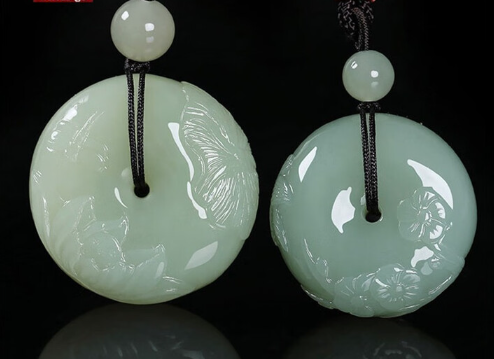
The ping an kou is a flat jade ring with a round outer edge and a round hole in the center — sometimes called a jade “donut” in the West. The name literally means “peace and safety buckle.” Its simplicity is the point: no deity, no animal, no ornament. Just a circle (heaven) around an opening (a passageway), worn to keep the wearer safe through life’s transitions. It’s the most common protection piece in China and one of the most affordable ways to wear real jade.
Jade Buddha — Laughter and Fearlessness
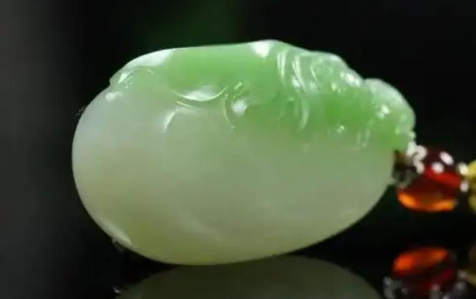
The laughing Buddha (usually Budai, not the historical Buddha) is carved for happiness and protection alike. The belief is that his open laughter scares away negative energy and small-minded worries. For people who face stress or conflict in daily life, a jade Buddha pendant is the traditional pick.
Guanyin — The Compassionate Guardian
Guanyin, the bodhisattva of compassion, is the most beloved protective figure in Chinese Buddhism. A jade Guanyin pendant is traditionally given to travelers, new mothers, and anyone entering a difficult chapter. Folk custom often pairs it with gender: Guanyin for men, Buddha for women — though this convention is loose and increasingly ignored.
Pixiu — The Wealth Defender
Pixiu is a winged mythical beast said to devour gold and silver — and never let them out. It guards wealth rather than life. A jade Pixiu is considered doubly potent because it needs to be genuine jade to “work,” and the carving is usually detailed enough to reveal the stone’s quality.
Animals and Zodiac Pieces
Turtles (longevity), dragons (power), horses (success), and your own zodiac animal (personal alignment) all appear in protective jade. A zodiac piece is a particularly popular gift for children — the belief being that your own animal sign understands your nature and guards it.
→ Comparing pieces for a gift? Our Jade Pendant Gift Guide breaks down styles, occasions, and price ranges.
Which Jade Color Protects You?
Traditional color symbolism adds another layer. While any genuine jade can be worn for protection, certain colors are matched to certain kinds of guarding:
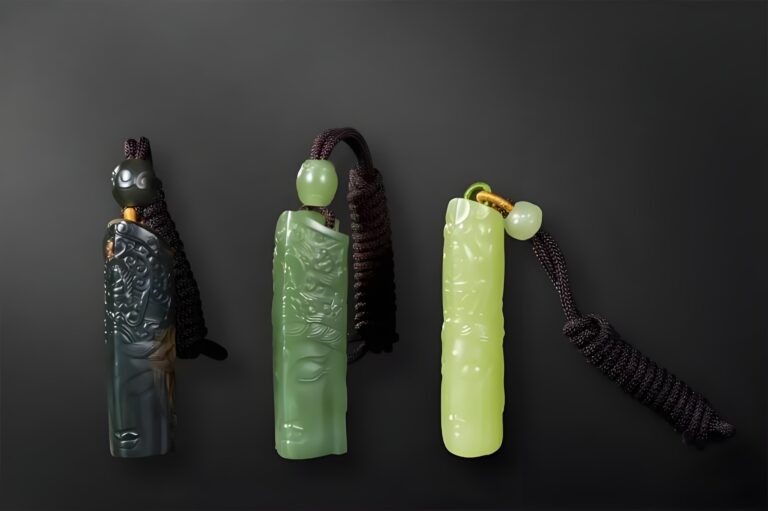
- Green — the classic protective color, tied to the heart, growth, and life force. If you’re choosing one jade for protection and want tradition on your side, green is the answer.
- White — purity and clear judgment. Traditionally worn to guard the mind from confusion and negative influence.
- Lavender — calm and emotional protection. Often chosen by people going through grief or upheaval.
- Yellow and honey tones — earth energy and stability, believed to ground a restless spirit.
- Black (ink jade) — the strongest “shield” color in folk tradition, absorbing negativity rather than reflecting it.
→ See Jade Color Meaning: Green, White, Lavender, and More for the full breakdown of colors and their symbolism.
How to Wear Jade for Protection: The Traditional Rules
If you follow Chinese custom, there are right and wrong ways to wear protective jade. These aren’t laws — but they’re the practices the tradition actually prescribes.
- Wear it on the left. The left side is traditionally considered the receiving side of the body — the side that takes in energy. Protective jade goes on the left wrist or worn so the pendant rests on the left of the chest.
- Let it touch your skin. Jade protects through contact. A pendant worn over clothing is a pendant doing half its job.
- Keep it on, consistently. The belief is that jade bonds with its wearer over time, growing warmer and more lustrous from body contact. A piece worn once a week is a stranger; a piece worn daily becomes yours.
- Don’t let others wear it. Traditional thinking says jade absorbs the energy of its owner. Lending your protective piece means lending your protection away.
- If it cracks, retire it with respect. A cracked protective jade is considered one that has done its duty. The custom is to wrap it in red cloth rather than throw it away.
- Gift it — don’t buy it for yourself (sometimes). There’s a divided folk view: some say protective jade should be received as a gift to carry the giver’s goodwill; others say self-purchased jade is fine because the intent is yours. Either way, the protective pieces passed down in families are the most treasured.
Cleansing and Renewing Your Jade’s Energy
Tradition holds that jade, like any guardian, needs maintenance. The usual practices are simple:
- Rinse in cool running water to wash away accumulated energy. Avoid hot water — heat can damage treated jade and dull the polish of any jade.
- Moonlight overnight is the traditional “recharge,” especially during a full moon. Sunlight is generally avoided, both for energy reasons and because prolonged UV can fade some dyed stones.
- Physical cleaning matters more than ritual. Oils and sweat build up on jade worn against the skin. Mild soap, cool water, and a soft cloth keep the stone at its best.
→ Jade also has a whole wellness dimension beyond protection — rolling, gua sha, and cool-stone therapy. Read Jade Healing Properties and Benefits.
An Honest Note: What Jade Can and Cannot Do
Let’s be direct, because trust matters more than folklore: there is no scientific evidence that jade blocks misfortune, absorbs accidents, or deflects negative energy. Anyone selling jade as a supernatural force field is overstating the case.
What’s real is this:
- The psychology of talismans is real. Research on “lucky charms” has shown measurable effects on confidence, persistence, and performance. A stone you believe protects you genuinely changes how you walk into a room.
- The daily reminder is real. A jade pendant touching your skin all day is a private signal — of family love, of cultural roots, of the intention to stay calm and upright. That signal has value regardless of metaphysics.
- The inheritance is real. A grandmother’s bracelet carried for thirty years protects something no insurance policy covers: continuity. People wear these pieces to stay connected to the people who gave them.
Protection, in the end, is the story people have told about jade for five thousand years — and stories are not nothing. Just don’t skip the helmet because you’re wearing a bracelet.
Buying Genuine Protective Jade: A Quick Warning
Because protective jade is such an emotional purchase, it’s also a target for fraud. Polymer-filled Grade B jade, dyed Grade C jade, and lookalike stones (serpentine, aventurine, prehnite) flood the market, often sold as “genuine jade bracelets for protection.”
- Insist on Grade A (natural, untreated) jade if authenticity matters to you — and for a piece you’ll wear daily for years, it should.
- Test before you trust. → How to Identify Real Jade: 7 Tests You Can Do at Home
- Match your budget honestly. Real protective jade starts cheaper than most people think — a small Grade A nephrite safety buckle costs less than a restaurant dinner. → How Much Is Real Jade Worth? Price Guide
Frequently Asked Questions
Can I wear jade for protection every day?
Yes — daily wear is actually the tradition. Jade is tough enough for continuous wear, and consistent skin contact is believed to strengthen the bond between stone and wearer. Just avoid hard knocks (sports, gym equipment) and remove it before swimming in chlorinated pools.
What happens if my jade bracelet breaks?
Tradition says the jade absorbed a blow meant for you and fulfilled its duty. The customary response is to thank the piece, wrap it in red cloth, and replace it — not to keep wearing the fragments. Scientifically, jade bracelets break from impacts and stress fractures, so check yours occasionally for hairline cracks.
Should I buy protective jade for myself or wait for a gift?
Both views exist in Chinese tradition. Gifted jade is said to carry the giver’s blessing, which makes it popular for birthdays and births. Self-purchased jade is perfectly acceptable — your own intent is the intent that matters most. The strict “never buy your own” rule is more folklore than consensus.
Is nephrite or jadeite better for protection?
Symbolically, either works — the tradition long predates the distinction. Practically, nephrite is tougher (better for a bracelet that gets knocked around), while jadeite takes a finer polish and higher transparency (better for a showcase pendant). Choose by piece and budget, not by which mineral is “more magical.”
Can children wear protective jade?
Yes, with the usual safety caveats. Chinese families commonly give babies and small children jade safety buckles or zodiac pendants. For infants, avoid long cords and small detachable parts; a smooth, short-strand piece is the safe choice.
Does the jade need to be blessed or activated?
Some buyers have jade blessed at a temple, which is a lovely ritual if it’s meaningful to you — but it’s optional in the broader tradition. What the custom emphasizes is consistent wear and care, not ceremony.
The Bottom Line
Jade’s protective reputation is one of the longest-running beliefs attached to any stone on Earth — a conviction strong enough that Han princes were buried in it, scholars lectured on its virtues, and families still pass it from mother to daughter today. The protection it offers may be psychological, cultural, and emotional rather than supernatural. But those are real forces in a human life, and jade carries them better than perhaps any other stone.
Choose genuine jade, pick a symbol that speaks to you — a safety buckle, a Buddha, a Guanyin — wear it on the left, against the skin, and let it do what it has done for five thousand years: quietly stand guard.
→ Explore the complete Chinese Jade Guide →
→ More jade meanings and symbolism →